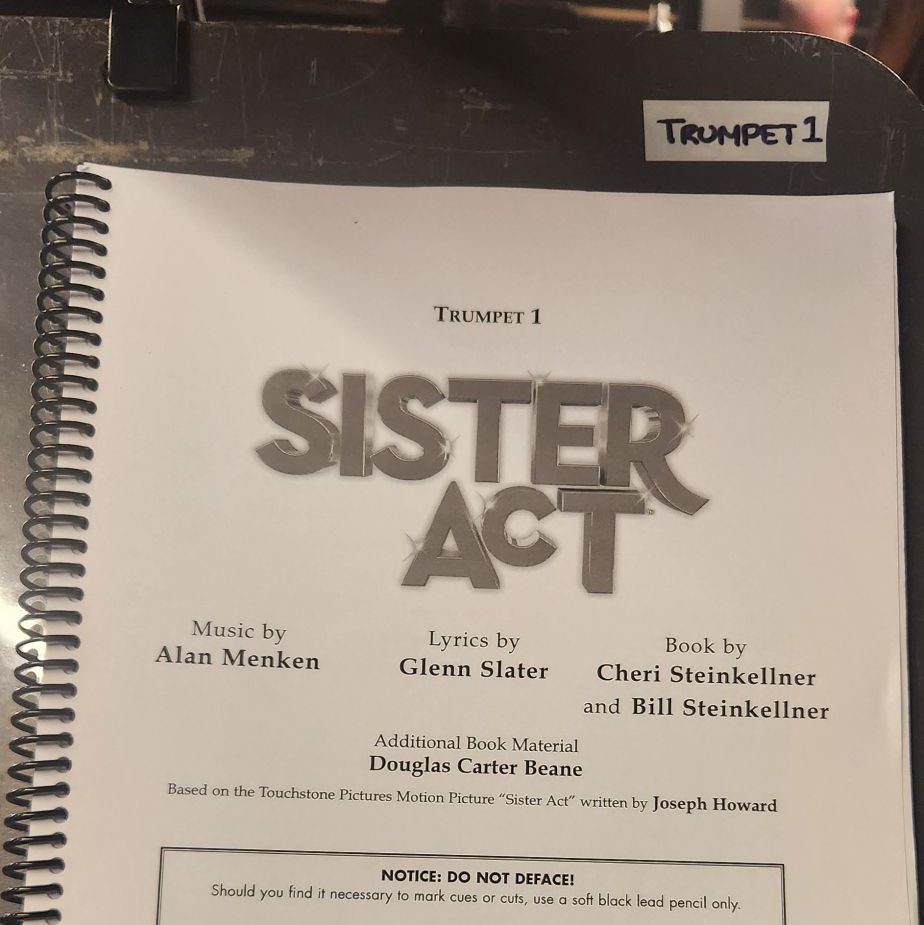
My most recent musical venture was playing the trumpet 1 book for “Sister Act: The Musical“. This is in no way a review for this particular production, but it is the catalyst for this blog altogether. Sometimes as a “receiver” (i.e. audience member) we forget what it takes to pull off a production at any scale, but particularly any that utilises a live band/orchestra (generally is and will be referred to as the orchestra, no matter the instrumentation or size).
Sister Act: The Musical features a gospel and disco driven musical score, with hints of Disney-esque story-telling in some of the more serious moments. Alan Menken and Glenn Slater are the minds behind this music, the former being responsible for many Disney film scores. The influence shows.
The physical books (parts) are well crafted and the player is considered immensely well for their page turns, range, stamina, instrument changes (reeds, trumpets, bass) and mutes (trumpets and trombone). Only one awkward change happens where the trumpets have to quickly change from muted trumpet to flugel, then change back. Trumpet players will understand this, in putting one instrument down on a stand you then pick up the other, pick up the mute, insert in the bell, then take a breath and play. Both of us managed the change without incident every show, but it got me thinking up a rack-style trumpet and flugel mount so a trumpet can be set up with mute ready for quick changes like that. There’s one or two of these quick mute or instrument changes every show – I think the worst I’ve come across is Wizard of Oz!
There are some incredibly clever inclusions in the books too. I highly appreciated the cues written in most sections of the numbers, but something of note was how the instrument is mentioned. You see, above a cued part lies the instrument name that will play those notes. If it was a “real” instrument, that is, the physical instrument was in the orchestra being played on the night, it would be cued as flutes or clar. or tbn, for example. But if the instrument was being synthesized, that is, played on one of the three keyboard parts, it would be cued as “bassoon” or “piano” or “strgs”. If both were together, it would be flute/”bsn”. See those quotation marks? It made me giggle when I figured it out. And if this is the case for every other book I’ve ever played, then I have been ignorant long enough!
On other clever musical inclusions, there are a few nods to popular guitar riffs hidden in that part, which our guitar player noticed straight away but took the rest of us a few shows to catch. It’s the kind of thing you hear if you know what to listen out for…and it makes my music nerd heart burst with joy at clever moments like this.
You want a spoiler? Hmm…have you ever seen “Wayne’s World”?
Now my review of SPECIFICALLY the trumpet 1 book – this takes some chop to get through a run of shows. On a two-show day at the very end of the run, I lost my very last note (a top E for those asking). And I don’t think it was really missed. The show BEGINS with a rip to a top D, then stays in the upper part of the stave and above for the next 2.5 hours. You’ll need a top G, a couple of Fs but Cs, Ds and Es a-plenty. There’s an optional A, but since it’s pinged out at the end of a number, it’s a risky splat. Nothing is too technically demanding, provided you’re comfortable with a brief stint in 6 sharps and expanding intervals. The part plays enough to be engaging, solidly/soloistically enough to keep it fun, and the flugel parts aren’t just for low long notes – they are really lovely especially when playing with the trombone. 2nd trumpet matches 1st infrequently, keeping the harmonies fresh and punchy. My 2nd trumpet player would absolutely scream his part when it was above the stave (which was always the unison parts) so I took a chance to rest the chops in these rare spots. They also get a few solo moments so there’s fun to be had in either book.
My favourite part comes during Act 1’s “Raise Your Voice” where there are 4 top Bs, one per bar, just absolutely popped out. I nailed this every show, and the joy I felt performing these four notes was electric. Myself, trumpet 2 and the trombone player all celebrate and shake hands after this part.
Everyone I could hear or speak to said the orchestra was excellent. It was, and was guaranteed to be with the line up we had. The musicians in this city are of a phenomenal class, most playing for the love of music or their hobby. Keep in mind this is community theatre, not professional. The musicians get paid an honorarium for every rehearsal and show, and it’s not very much. We do love the craft, and we all have full-time jobs and/or lives outside of the orchestra pit. I and a few others teach music during the week, so I consider myself one of the lucky ones who get to do this all the time.
The orchestra is often relegated to a half-sentence after-thought in any review. It’s invariably along the lines of “the music was ably led by the musical director” then misspell the MD’s name – yes, I’m sour because I have a name that is always misspelled. For this Sister Act, we had the same, so our MD offered his own review:
“Working through an Alan Menkin score is tricky enough, but one that plays jump rope with Disco/Gospel and Traditional Disney could have been a bridge too far with a lesser group of musicians.
However, Phillipoi Keavnovich” – the misspelled MD joke, of course – “and his band of misfits, transition effortlessly between moods, modes, and motifs, never missing a beat. And it should be noted that a few of those previously mentioned ‘occasional fluffs’ were not only caught by this professional group, but cradled to a safe and comfortable landing that only a seasoned theatre-goer would have noticed.
Yet another example of how lucky this level of community theatre is to have access to such a high level of musicianship.” – Phil Kearney
I must voice that this is not a musical I would choose to see. Though the music is immensely fun, none of the songs from the original film appear in the musical, so don’t go looking for them. A couple of musical numbers we could probably do without – Act One has 9, and Act Two has 12 PLUS entr’acte, bows, “encore”, and play off music. It’s overly long. I don’t think the story-telling is strong, nor the characters very compelling, and all the humour is found singly in Mother Superior, which is always the same joke – she finds Deloris frustrating. Many other jokes go completely missed. There’s a love interest, but it’s so forced.
I also must have missed the whole purpose for this show, as in, what was the theme? Was there a moral? A story? Or was this purely for entertainment’s sake? Or perhaps it’s possible that not every musical film needs to be a stage musical?
Speaking of “jokes”, here’s one during Act 1’s “Here Within These Walls”:
Deloris: “If I have to wear this, I will just drop dead!”
Mother Superior: “Well then, we have a plan.”
…we couldn’t think of something else?
So there you have it, a glimpse into this one particular show from the best seat in the house – the one that sees only the underside of the floorboards, hears the footsteps and the trolley wheels across the stage, and is quoting you every night during their favourite lines.
– Britteny Muso


Leave a Reply